


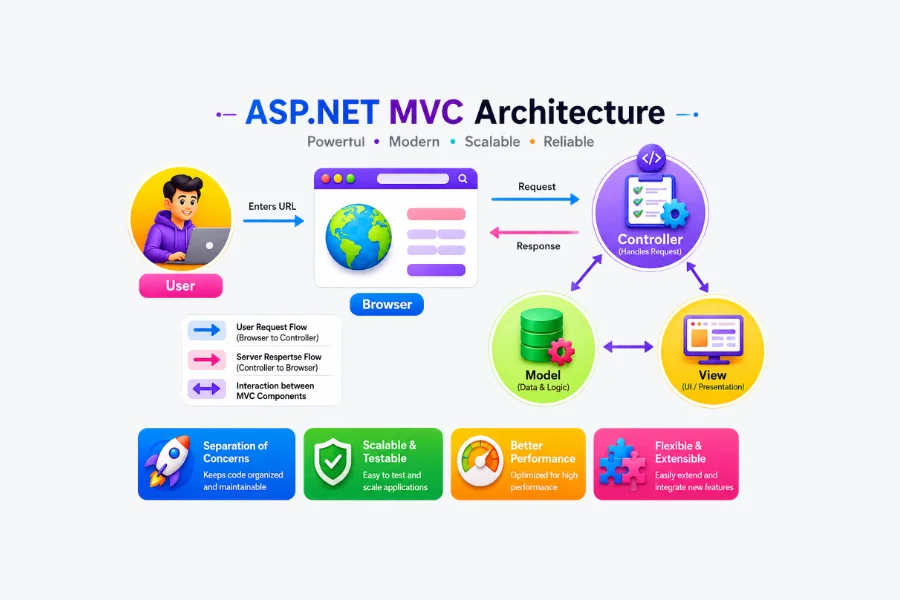
ASP MVC Solution Architecture
Building efficient digital systems requires a structured approach that keeps applications organized, manageable, and adaptable. ASP MVC architecture provides a clear development framework that supports smoother application performance, easier maintenance, and scalable business functionality.
At 9to5 Networks, we create ASP MVC solution architecture designed to simplify complex business requirements and transform them into well-structured digital systems. From enterprise applications and management platforms to customized web solutions, every project is developed with precision and long-term usability in mind.
A well-planned architecture creates stronger foundations for business applications and allows systems to evolve without unnecessary complexity. Our approach focuses on delivering practical, organized, and adaptable solutions that align with changing business needs.
ASP MVC solution architecture designed to deliver secure architecture, seamless functionality, optimized performance, and scalable systems for business applications.
Future-Ready Framework
Build organized application systems designed for flexibility and long-term performance.
- Flexible system design
- Organized code structure
- Streamlined application flow
- Scalable MVC architecture
- Easy application maintenance
- Secure enterprise applications
Structured MVC Architecture
The Model-View-Controller pattern separates an application into different responsibilities, making it easier to organize and manage complex software systems.
The Model generally handles application data and business logic, while the View manages the presentation layer. The Controller handles user requests and coordinates interactions between the other components.
This separation can make applications easier to develop, maintain, test, and modify as requirements change. Microsoft’s documentation also explains how ASP.NET Core MVC uses the Model-View-Controller pattern to separate application responsibilities.
Our ASP MVC solution architecture approach uses this structured model to create applications that are easier to manage, maintain, and adapt.
Scalable Business Applications
Businesses often need applications that can grow alongside their operations. A system that works for a smaller operation may require additional functionality as the organization expands.
ASP MVC solution architecture can provide a structured foundation for developing applications with multiple modules, workflows, users, and business processes. The architecture can be organized according to the specific requirements of the application and its expected usage.
Additional functionality can be introduced as requirements evolve, helping businesses maintain a consistent application structure while reducing unnecessary complexity during future development.
Improved Application Maintenance
Maintaining a complex application becomes easier when its components are properly organized and responsibilities are clearly separated.
A structured MVC architecture can help developers identify specific areas of an application when making updates, adding functionality, or resolving technical issues. Separating presentation, application logic, and data-related responsibilities can also make future modifications more manageable.
This is particularly useful for businesses that expect their applications to undergo regular updates, feature improvements, integrations, or changes in business workflows.
Performance and Reliability
Business applications need to remain responsive and dependable as users and workloads increase. Application architecture plays an important role in creating an organized foundation for performance-focused development.
Our ASP MVC solution architecture focuses on creating structured application environments that support efficient workflows and reliable functionality. Development decisions can be aligned with the expected workload, features, integrations, and long-term requirements of each project.
A well-organized application foundation can also make it easier to identify areas that require optimization as the system develops and business requirements become more complex.
Integration With Business Systems
Modern applications rarely operate completely independently. Businesses may need their applications to communicate with databases, APIs, payment systems, customer management platforms, reporting tools, or other enterprise software.
ASP MVC applications can be developed with integration requirements in mind, allowing different systems and services to work together as part of a connected digital environment.
Our development approach considers integration requirements during the planning and architecture stages. This helps create applications that can communicate effectively with existing systems while remaining organized and maintainable.
Secure Enterprise Architecture
Security is an important consideration when developing applications that manage business information, user accounts, transactions, and other digital interactions.
Our ASP MVC solution architecture approach considers application structure, user access, data handling, authentication, integrations, and other technical requirements while developing business-oriented systems.
The exact security implementation depends on the application, its data, users, integrations, and operational environment. This allows security considerations to be incorporated according to the specific requirements of each project rather than relying on a fixed approach.
Flexible Application Development
Every business application has different requirements. An internal management system may require different workflows and integrations from a customer-facing platform or enterprise application.
Our ASP MVC solution architecture can be structured around specific business processes, application requirements, user roles, and operational objectives. This flexibility allows the development approach to remain aligned with how the organization actually uses its digital systems.
From custom dashboards and management platforms to enterprise applications and connected web solutions, the architecture can be planned around the functionality required by your business.
Why Choose 9to5 Networks?
Choosing the right technology partner can make a significant difference when developing a custom application.
At 9to5 Networks, we focus on understanding business requirements before developing technical solutions. Our approach combines application development, structured architecture, usability, scalability, and ongoing technical support.
Rather than applying the same architecture to every project, we consider the application’s purpose, users, workflows, integrations, performance expectations, and future requirements.
Our ASP MVC solution architecture services are designed to help businesses develop practical, maintainable, and scalable digital systems.
Whether you need an enterprise application, management platform, customized web solution, internal business system, or an application that can evolve with your organization, we can develop a solution around your operational requirements.
FAQs
Can applications be expanded in the future?
Absolutely. Additional modules, integrations, and functionalities can be introduced as business requirements evolve, depending on the application's architecture and technical requirements.
Is ASP MVC suitable for enterprise applications?
Yes. ASP.NET Core MVC is designed to support web applications and APIs, while its separation-of-concerns approach provides a structured foundation for developing and maintaining complex applications.
What makes ASP MVC suitable for business applications?
ASP MVC creates a structured development environment that separates different application responsibilities. This can help improve development organization, simplify maintenance, and make applications easier to adapt as business requirements change.
Can ASP MVC support customized business requirements?
Yes. ASP MVC solutions can be developed around specific workflows, business operations, user requirements, integrations, and functional needs. This makes the architecture adaptable to different types of business applications.
Can ASP MVC applications integrate with existing systems?
Yes. Applications can be developed to work with databases, APIs, enterprise platforms, authentication systems, payment services, and other business systems depending on the technical requirements of the project.
Services to Elevate Your Brand